Thursday, August 20, 2009

Funny Thing Write Wedding Card

The rice cracker

THE BASIC FLAT GEOMETRIC AND ART

geometry has always been one of the tools used by the artist in their work. For example, through her different structure elements within a particular artistic work , or create shapes that by themselves can be beautiful.

are called "center" those places that, within a play, hold the viewer's attention. The artist directs the centers of attention in his work used ndo as a resource, geometry.

THE TRIANGLE


AB

These two triangles are geometrically the same, but different from the artistic point of view. While that the triangle A, resting on its base, gives a feeling of rest or immobility, the triangle B, to be supported at its apex, seems to be in unstable equilibrium, in tension, as if any was time to move left or right.

These tri angles often used is to sort the centers of a work , with the intent to cause different sensations.

For example, e n the box i) has been used a scheme based on a triangle with the base well established and its apex at the top. S and seeks give a feeling of serenity and rest.

On the other hand, the inverted triangle or supported at its apex is used to show stress, conflict, indecision, etc.. For example, in the box ii) , the artist has used an inverted triangle structure to reflect the tension in balancing the confrontation between the two players who have not yet completed game.


i ) J. Van Eyck, "Madonna Enthroned breastfeeding the child." XV century


ii) P. Cézanne, "The Card Players," 1890

The following table represents Rafael gentleman in his sleep has to choose between the pleasures of beauty symbolized by the woman and the flower, or the culture and value, it is the woman with the book and the sword. As you can see, the composition scheme is presented through an inverted triangle, whose vertices are in the eyes of two women and heart of the knight.

P. Cézanne, "The Card Players," 1890


Of course you can also find works where and l triangle appears, not as a compositional resource, but as the main form. This work by Kenneth Noland, is formed by overlapping triangles.

Activity .

  • Search r, in work of Leonardo da Vinci , as a composite picture scheme triangular .

Bibliography : - Plastic and Visual Education, 1 cycle of ESO. Abado Ruiz, Ma Luisa and others.

- "The sixteenth century Italian Renaissance " . Valdearcos , Enrique.

Friday, December 5, 2008

West Point Ny Gay Cruising

RUBIK'S CUBE

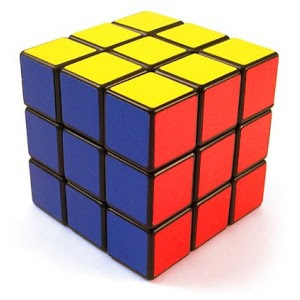
Rubik's Cube (or magic cube, as it is known in some countries) is a mechanical puzzle invented by the sculptor and professor of architecture Ernö Rubik in 1974. It is a popular puzzle game whose faces are divided into squares of the same solid color each, which can be moved. The object is to disarm the initial configuration in order and reassembly.
It is estimated that more than 100 million Rubik's Cubes and imitations have been resolved over
world. The cube celebrated its 25th anniversary in 2005 as a special edition of it was released in which the white face was replaced by reflecting on the reading "Rubik's Cube 1980-2005.
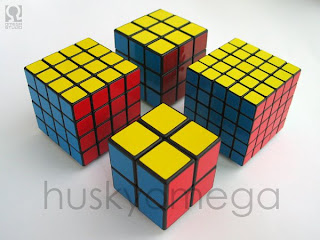
characteristic in the cube, each face is covered by nine faces of a solid color. When it is determined each face is the same solid color. However, the puzzle comes in four versions: the Pocket Cube 2x2x2, 3x3x3
the standard Rubik's Cube, the 4x4x4 Rubik's Revenge 5x5x5 and Professor Cube.


HISTORY OF THE CUBE

In March 1970 , Larry Nichols invented a 2x2x2 puzzle (similar to the known cubes Rubik's) and called "Puzzle with Pieces Rotatable in Groups". Nichols toy is held using magnets.

On 9 April 1970 , Frank Fox was presented to patent its "3x3x3 ball."
Ernö Rubik invented his "Magic Cube" in 1974. The first products of this invention went on sale in 1977
in toy stores Budapest. The Magic Cube joined by plastic parts assembled together, which were cheaper to produce than the magnets in Nichols. In September 1979 made a dealing with Ideal Toys to bring the Magic Cube to the West, and the toy first came to the toy out of Hungary in February 1980.
After his international breakthrough progress in toy bucket Western paused so that the toy could be adapted to Western standards of safety and packaging. A bucket was lighter and Ideal Toys decided to rename the "
The Gordian knot" and "Inca Gold" were considered but the company finally decided on "Rubik's Cube" and the first delivery was exported from Hungary in May 1980 . Because of the scarcity Product produced many cheaper imitations. Nichols
assigned his patent to his employer company, "Moleculon Research Corp., which sued the Company Ideal Toys in 1982
. In 1984 the Ideal lost the patent infringement suit and appealed. In 1986 the appeals court upheld the 2x2x2 Rubik's Pocket Cube infringed Nichols's patent, but reversed the trial on the 3x3x3 Rubik's Cube. Recently Inventor
Greek Panagiotis Verdes patented a method to create buckets beyond the 5x5x5 to 11x11x11. His designs, which include improved mechanisms for the 3x3x3, 4x4x4 and 5x5x5 are suitable for
speedcubing . Until April 4, 2008, these designs were not widely available although there are videos of prototypes up to 7x7x7 and solutions. It was announced that these cubes would be marketed in September 2008 through the brand "VCube."


RECORDS
New World Record, last July 13, Dutchman Erik Akkersdijk broke the world record in the Rubik's Cube establishing a new brand of 7.08 seconds in Prague during the Czech Open .

The previous record was held by Yu Nakajima with a mark of 8.72.

the record back and remain in this mode beaten in Murcia, where he set the previous record Nakajima and where they got off the first 10 seconds.

Another record, not in the same way but the more amazing, is that of David Calvo has not only surpassed the previous Guinness record (42 Rubik's cubes in one hour armed), but that has more than quadrupled, resulting 185 cubes resolve that if the accounts do not fail me, equivalent to 19.45 seconds per cube.